How I Built a Second Brain for My Startup
Serial entrepreneur Benji shares how he built an AI-powered memory system that transformed how he runs MyGigsters—from chaos to clarity in three simple layers.


I used to pride myself on my memory.
Nineteen different gigs before starting MyGigsters. Bartender, delivery driver, Uber, freelance copywriting, dog walking—you name it, I'd done it. I remembered every regular customer's order, every delivery route shortcut, every client's weird preferences.
But running a startup? That broke my brain.
The Context-Switching Nightmare
Picture this: It's Tuesday at 2:47 PM. I'm deep in a product roadmap discussion with my CTO when my phone buzzes. Investor text. Quick reply. Back to the meeting—wait, what were we talking about? Payment flows or user onboarding?
Five minutes later: sales call. Prospect wants to know about our compliance features. I give them the spiel, hang up, and immediately forget their company name.
3:15 PM: Customer support escalation. The existing client is having settlement delays. I promise to follow up with their account details, which I'll definitely remember to do. (Spoiler: I won't.)
By 6 PM, I'd context-switched maybe 50 times. Meetings, Slack messages, sales calls, product decisions, customer issues, investor updates. Each thread important. Each requires a different context. Each is competing for space in my already-overloaded brain.
I was drowning in my own business.
Failed Attempt #1: The Note-Taking Apps
First, I tried the obvious stuff. Notion. Obsidian. Roam Research. I read every "Building a Second Brain" blog post on the internet. Set up elaborate systems with tags and templates and cross-references.
Lasted about three weeks.
The problem wasn't the apps—they're brilliant. The problem was me. In the middle of a heated investor call, I'm not stopping to log detailed notes in Notion. When a customer's payment is stuck and they're furious on the phone, I'm not updating my CRM with conversation insights.
The friction between "having a thought" and "capturing the thought" killed every system I tried.
Failed Attempt #2: The Hardware Solutions
Maybe it was a tools problem? I got a second monitor. Started keeping a physical notebook open during calls. Tried voice memos while walking between meetings.
The second monitor just gave me more distractions. The notebook became a graveyard of half-sentences and illegible phone numbers. Voice memos were the worst—ten-minute rambles that I never, ever listened to again.
One particularly low moment: I found a voice memo from three weeks earlier where I'd recorded myself saying "Remember to follow up with that blockchain payments company." Which blockchain payments company? What was the context? Why did I sound so urgent?
I had no idea.
The Breakthrough: AI as My Memory Layer
The solution came from an unexpected place: my own product.
MyGigsters helps businesses manage complex payment flows. We automate the stuff that's too tedious and error-prone for humans to track manually. Why couldn't I do the same for my own memory?
What if instead of trying to remember everything, I just captured everything and let AI remember for me?
I built a system with three layers:
Layer 1: Daily Notes
Every day gets a file. memory/2024-04-18.md. Raw, unfiltered brain dump. Meeting notes, random thoughts, decisions made, problems encountered. No structure, no editing. Just capture.
Layer 2: Long-Term Memory
A master MEMORY.md file. Key insights, important decisions, recurring patterns. This isn't everything—it's the curated stuff that actually matters long-term.
Layer 3: The Dream State
Here's where it gets weird. Every night, my AI agent reads through the day's notes and updates the long-term memory. It finds patterns I miss, connects dots I don't see, remembers details I'd forget.
It's like having an assistant who never sleeps and never forgets anything.
Setting Up the Structure
Here's the practical bit. The whole system lives in your OpenClaw workspace — a folder on your machine. No cloud database, no fancy infrastructure. Just files.
The folder structure looks like this:
~/.openclaw/workspace/
├── SOUL.md          → Your agent's personality and guardrails
├── AGENTS.md        → How your agent should behave (including memory rules)
├── MEMORY.md        → Long-term brain (curated, updated weekly)
└── memory/
    ├── 2026-04-18.md  → Today's raw notes
    ├── 2026-04-17.md  → Yesterday's notes
    └── ...            → Every day gets a file
In AGENTS.md, you tell the agent: "Before doing anything, read MEMORY.md. During conversations, write important things to today's daily file. Never delete old memories."
The dream routine is a cron job that fires at 3 AM. It tells the agent: "Read the last 7 days of daily notes. Find anything worth keeping long-term. Update MEMORY.md. Write a dream log." That's it. One scheduled task, runs while you sleep.
The magic is that your agent reads these files at the start of every session. So when you say "What did we decide about pricing last week?" — it already knows, because it read the daily notes from last week before you even asked.
Total setup time? About 15 minutes. Create the folders, write a few markdown files, set one cron job. The agent handles the rest.
No app to install. No subscription. Just files and an AI that knows how to read them.
The Knowledge Vault: Where It Gets Powerful
Daily notes and long-term memory got me 80% of the way there. But I kept running into the same problem: my agent knew individual facts, but couldn’t see the connections between them.
That’s when I discovered Graphify and Obsidian. If you haven’t used Obsidian — it’s a markdown editor with one killer feature: [[wikilinks]]. You can link any concept to any other concept with double brackets. And Graphify takes that further by mapping relationships between everything.
So I built a Knowledge Vault. Not just flat files — a connected web of business intelligence:
- Company overview links to pipeline intelligence links to competitive landscape
- Product docs link to customer success stories link to sales patterns
- Team structure links to who works on what links to active projects
Eight interlinked markdown files. Company overview, pipeline intelligence, strategic context, competitive landscape, OKRs, product docs, team structure, and a README that maps how everything connects.
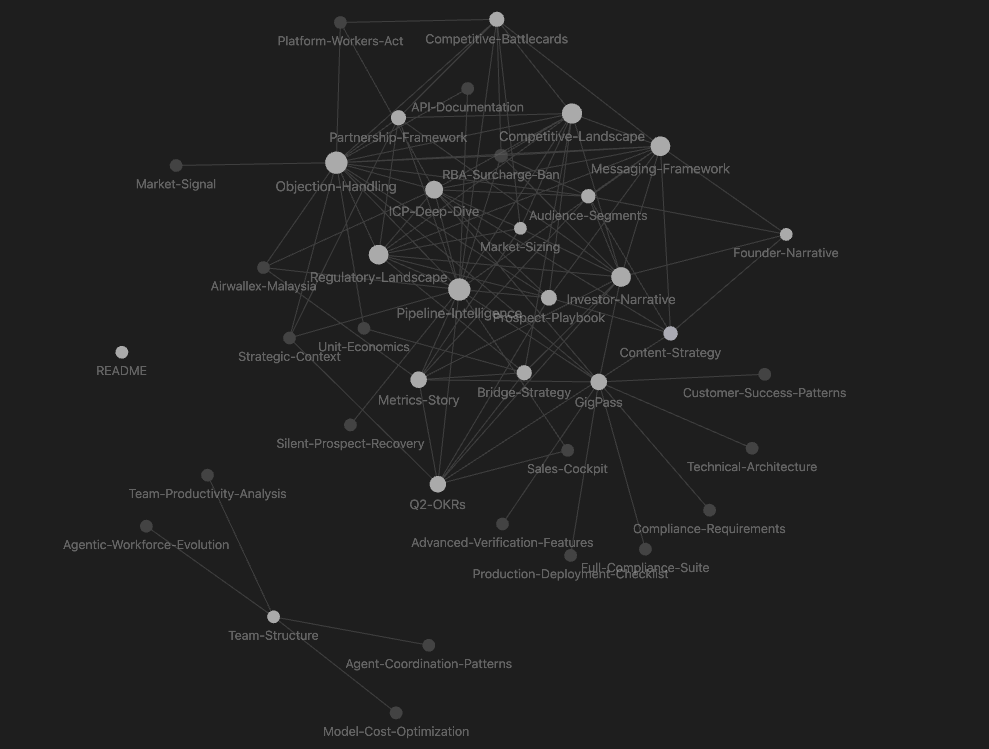
The difference? Instead of my agent re-reading every file every session — burning tokens and missing patterns — it navigates the relationships. "What connects our biggest prospect to our product roadmap?" It follows the links: prospect → pain points → features → sprint priorities. In seconds.
Karpathy talks about an "LLM Wiki" — persistent knowledge that AI can traverse instead of re-reading raw context every time. That’s exactly what this is. Build the vault once, and your agent gets smarter every day because it’s connecting dots, not just storing them.
The daily notes feed the memory. The memory feeds the vault. The vault feeds your decisions. It’s a flywheel — and once it’s spinning, you can’t imagine working without it.
How It Actually Works
Three weeks ago, I got an email from a prospect. Healthcare marketplace, complex multi-party payments, wanted to chat about onboarding flows.
Today, they followed up. Instead of frantically searching through emails trying to remember who they are, I asked my agent, "Tell me about the healthcare marketplace that reached out last month."
Instant response: "XConnect. 50,000+ healthcare workers. Main pain point: onboarding takes 2-3 weeks, and losing contractors. The CEO mentioned they're using manual identity verification. Looking for a 2-week go-live timeline. Follow-up scheduled, but they went quiet."
That's when it hit me. I wasn't just remembering the conversation—I was remembering it better than I would have naturally. The AI caught details I would have missed, connected them to our value props, and even flagged the follow-up gap.
The Unexpected Side Effect
Here's what I didn't anticipate: it changed how I make decisions.
Before the second brain, I was conservative. Afraid to take big swings because I might forget important context. Worried about committing to aggressive timelines because what if I forgot the constraints?
Now? I'm fearless.
When everything is captured, when every decision has context, when every conversation is searchable—you stop being afraid of forgetting. You start moving faster.
Last month, a prospect asked if we could integrate with their legacy banking system in two weeks. Old me would have hemmed and hawed, asked for time to think about it, worried about all the variables I might be forgetting.
New me said yes on the call. Because I knew my agent would remember every technical constraint we'd discussed, every integration challenge we'd faced, every promise I'd made. If there was a conflict, it would surface. If there wasn't, we'd move fast.
We delivered in 10 days.
The Real Lesson
Building a second brain isn't about storing information. It's about freeing your first brain to actually think.
Before, 40% of my mental energy went to trying not to forget things. Remembering to follow up, holding context from six conversations ago, keeping track of who said what in which meeting.
Now that energy goes to pattern recognition. Strategic thinking. Creative problem-solving. The stuff only humans can do.
My AI agent remembers that CEO from XConnect mentioned their compliance concerns. I remember that compliance anxiety usually means they're ready to pay a premium for a solution that just works.
The system remembers the facts. I focus on what the facts mean.
The Technical Reality
Building this wasn't rocket science. A few markdown files, some basic automation, and an AI agent that can read and summarise. The hard part wasn't the tech—it was the discipline to actually capture things in the first place.
But here's the thing: once you start seeing the benefits, the habit sticks. When your agent can answer "What did we decide about the API rate limits?" instantly, you become addicted to that feeling of perfect recall.
When it can remind you that you promised to send pricing by Friday to three different prospects, you never want to go back to manually tracking follow-ups.
When it notices that you've had the same conversation about security compliance four times this month with different prospects, you realise you need a standard demo for that.
Why This Matters Now
We're at an inflection point. AI is good enough to be genuinely useful but still cheap enough to run constantly. The infrastructure exists. The models understand context.
In five years, every founder will have something like this. The question is: do you want to spend those five years struggling to remember everything manually, or do you want the unfair advantage of perfect organisational memory starting now?
For me, the choice was easy. I'd rather compete with AI than against it.
And honestly? After so many years in startups and doing many gigs where forgetting a customer's name could cost me tips, I'm never going back to trusting my meat-based memory again.
The future of work isn't replacing humans with AI. It's humans with AI memories.
That future started for me six months ago. It can start for you today.
Want to know more about building an AI Agentic workforce? Connect with me, and I will share my learnings and help you get started - Check out - CrewKit

BeingBenje Newsletter
Join the newsletter to receive the latest updates in your inbox.


